Pages

Showing posts with label basic concepts. Show all posts

Sunday, June 24, 2012

The Scarcity Problem

The Scarcity Problem

The fundamental problem (sometimes referred to as "the economic problem") that economists study is one of scarcity.

Scarcity itself can be defined in several different ways (limited resources, having to make a choice between alternatives, etc.), but its meaning is always the same:

scarcity implies that there ain't enough to go around, yall

That's it.  It's really no more or less than that.

Scarcity is also a concept that varies depending on the situation.
For example, in the desert, water is a scarce resource, because there isn't enough to go around.

water is scarce in the desert.

But in, say, a swampy area, water is not a scarce resource.  In fact, something completely different, like dry ground, could be considered a scarce resource in a swampy environment.

Scarcity swamp alligator

Regardless of the specific resource, scarcity necessitates choice.  That is, because a resource is scarce, a decision maker must choose between two or more alternatives.  You can't have your cake and eat it too.

Scarcity choice alternatives decision

In a decision-making situation, sometimes there is more than one scarce resource.  For example, instead of buying several different kinds of deodorants at once, you might only be able to choose one type of deodorant.  This could be because your money is scarce, but it could also be because your space is scarce, too.  Perhaps your bathroom medicine cabinet only has room for one stick of deodorant, so you can only buy one stick at a time.  

sad, empty pockets

For most of us, money is a scarce resource.  In fact, scarcity of money is the reason many people develop budgets, or consult financial planners.  These tools and services are used in order to figure out how to best allocate limited funds.  

It's interesting to take this (simplified) view of scarcity and apply it to everyday life.  You might be surprised at some of the crazy ways scarcity emerges, and how much it influences the decisions we all have to make on a daily basis.  Scarcity, essentially, is what economists study.  It's basically what you're studying in most economics classes, whether you like it or not.  


Wednesday, May 30, 2012

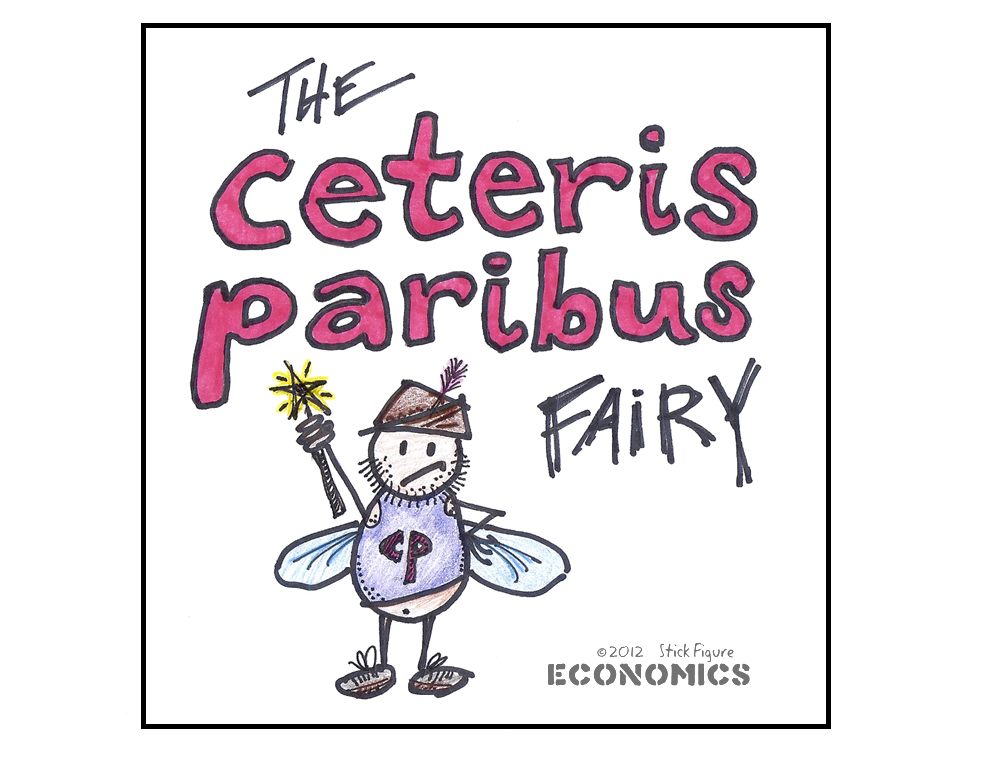
The Ceteris Paribus Fairy

The ceteris paribus fairy explained


This is how I think about the concept of ceteris paribus in economic thought.  It’s a nice way to make things work out swimmingly, but reality often paints a different picture.  Fairies are a convenient mascot for something like this.


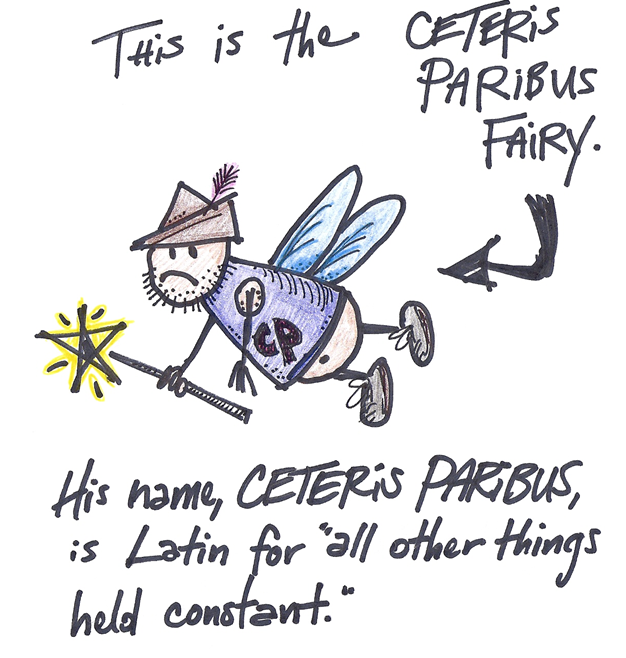
This is the Ceteris Paribus fairy.  His name is Latin for "all other things held constant."


Sometimes the Latin translation varies depending on the source, but the meaning is the same.


How to pronounce "Ceteris Paribus"


The first econ professor I ever had referred to ceteris paribus as “KET-err-iss”, and I can’t seem to quit pronouncing it like that, even though it’s not the correct Latin pronunciation.


Ceteris Paribus Fairy's power: keeping all other things constant!

 It’s not bippity boppity boo or anything that amazing, but still.


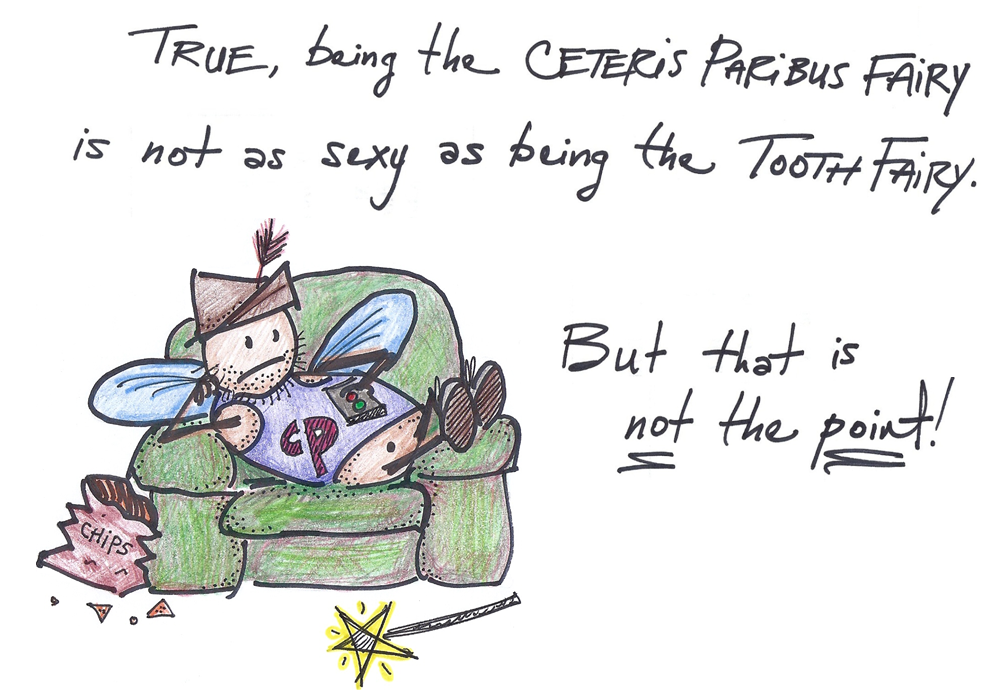
Ceteris paribus fairy is not the same as the tooth fairy, but oh well.


Ceteris Paribus Fairy doesn’t care about sexiness.  Might he need a shave and a gym membership?  Perhaps.  But who are we to judge?


No matter what the situation, he holds all other variables constant.
Again, he’s not turning teeth into money or anything that amazing.  
But it’s still an important power to wield, at least in economics.


Hootie is a good dog when he goes on walks, ceteris paribus.

Really, he is.


Hootie is a good dog, as long as everything else is kept constant.


Without the magical presence of the Ceteris Paribus Fairy, Hootie is not a good dog when he goes on walks.  
In fact, most of the time, he is a complete spaz on walks.  


Hootie being a spaz on his walk


That's because without the Ceteris Paribus Fairy around to hold all other variables constant, Hootie (the well-meaning dog that he is) is easily distracted.  And my chances of being dragged along as he chases a squirrel up a tree are increased.  By a lot.  


In essence, the Ceteris Paribus Fairy allows us to make predictions with confidence about Hootie’s behavior during a walk, regardless of the environment or circumstances. 


"What gives?" you might say.  Why even bother with the Ceteris Paribus Fairy when he never seems to be around in real life?  


Well, the answer is because he's an essential part of basic economic theory.  And if you, a hapless student of economics, refuse to believe in the existence of the Ceteris Paribus Fairy, you'll doubtlessly end up thinking too much about what else could happen in the situation at hand.  It's a flaw most smart, logically-thinking people fall into.  On economics exams, it often results in wrong answers and bad exam grades.  


So go ahead.  Take advantage of the Ceteris Paribus Fairy.  In fact, he wants you to.  Really.  And your grades might just thank you for it.  


--------------------------------------------------------------------------------------------------------------------------
Like these graphics?  Want to use them in your classroom?  Click here to buy the PowerPoint file, and thanks for your support!