Pages

Showing posts with label history. Show all posts

Wednesday, June 6, 2012

Ray Bradbury and the Economic Impact of Libraries

Ray Bradbury portrait


Ray Bradbury died Tuesday at the age of 91.  In 1953, he wrote Fahrenheit 451, which is one of my all-time favorite books.  

Bradbury, who was always an ardent supporter of public libraries, had this to say about them: 
"Without libraries, what have we?  We have no past and no future."
In honor of Ray Bradbury's legacy, today's topic is...

title slide: the economic impact of public libraries

Public libraries have existed in the U.S. for a long time.  In fact, Benjamin Franklin founded the first public lending library in an effort to make educational texts available to his colleagues.  After that, libraries were viewed as a portal to information, education and the outside world.  In that sense, they were very powerful institutions.

Things changed, though, especially with technological advancements.  The internet, in particular, makes it easy for people to find information about the outside world without even having to set foot in a library.  Does this mean libraries are less useful now than they were before?  

Well... 

libraries become more popular during recessions

This makes intuitive sense, because the emptier people's pockets become, the more likely they are to head to the local library to use its free (or low-cost) services.  It's much cheaper to borrow a book from a library than to buy a brand new one, right?  For the many people affected by the recession, visiting the library becomes an attractive option.

Still convinced that nobody is visiting the library?

69% of the population are library users.

That's well over the majority of adults in the U.S. - an enormous proportion of the population.  All library users.

99% of libraries have free internet.

This means that these libraries are providing a means for community members to access the wealth of information that the internet has to offer.  That is a big deal, especially if there aren't any other ways for people to get online in the area.
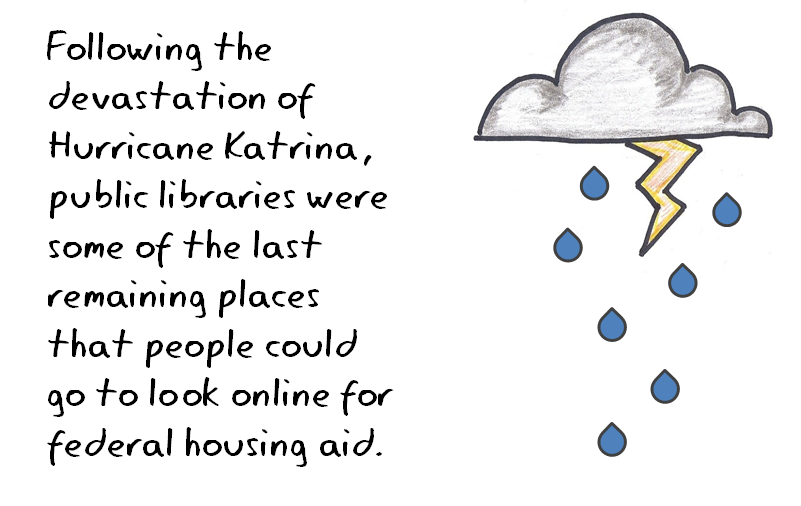

Victims of hurricane Katrina used libraries to find housing.

Hurricane Katrina victims who were able to search online for aid received help faster than those who could not access the internet.


demographics of library patrons

Libraries are used by all different types of people, from those who are impoverished, to retirees, to college-educated individuals.  As a result, they serve all sorts of purposes.
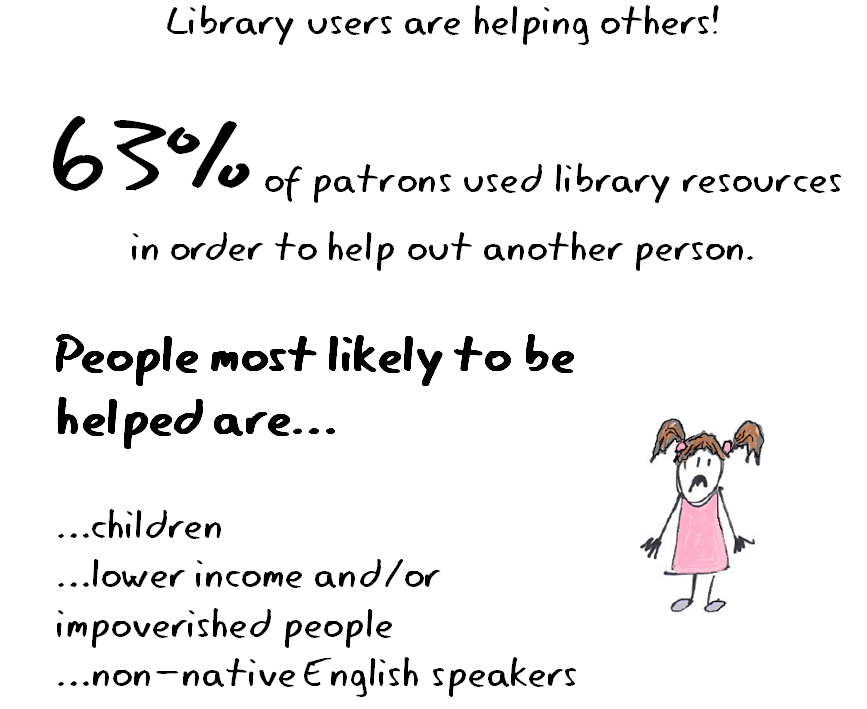


libraries are places where people help others

So a majority of library visitors are there to help someone else?  Sounds like a community-oriented place to me.


libraries bring communities together

A third of all public library patrons use the library to become healthier and/or more active members of their communities.  This has a positive impact on overall community development.  Community-oriented?  Of course!

25% of people use the library for personal finance

So aside from all the other great stuff that public libraries offer, it's also a place where people can learn about and organize their personal finances.  This is incredibly important, especially during difficult economic conditions, when being organized with money can mean the difference between getting bills paid or not.

Speaking of paying the bills...

ROI for public libraries in the U.S. is $4.52.


It's true.  And it's not a bad return on investment, if you compare it to alternatives like the stock market or current interest rates.

Ultimately, public libraries positively impact the communities in which they serve.  By keeping public libraries useful, comprehensive, and well-funded, Ray Bradbury's legacy survives.  

Support your local library!  (And read Fahrenheit 451 if you haven't already.  It's a quick and relatively painless book to read, and you'll be glad you did.)


References used in this presentation:

American Library Association.  "Library Fact Sheets."  Accessed June 6, 2012. http://www.ala.org/tools/libfactsheets

American Library Association.  "The State of America's Libraries, 2011."  Special report.  Accessed June 6, 2012.  http://www.ala.org/news/sites/ala.org.news/files/content/mediapresscenter/americaslibraries/state_of_americas_libraries_report_2011.pdf

Institute of Museum and Library Services.  "Public Libraries Survey, Fiscal Year 2009." June 2011.  Accessed June 6, 2012.  https://harvester.census.gov/imls/pubs/Publications/fy2009_pls_report.pdf

Institute of Museum and Library Services.  "Strategic Plan: 2012-2016." Accessed June 6, 2012.  http://www.imls.gov/assets/1/AssetManager/StrategicPlan2012-16_Brochure.pdf

Steffen, Nicolle and Zeth Lietzau.  "Public Libraries - A Wise Investment: A Return on Investment Study of Colorado Libraries."  Library Research Service, March 2009.  Accessed June 6, 2012.  http://www.lrs.org/documents/closer_look/roi.pdf

Washington State Library.  "Report on Public Library Usage Stats During Recession (2009)."  Accessed June 6, 2012.  http://www.sos.wa.gov/library/ReportonPublicLibraryUsageStatsDuringRecession2009.aspx


Tuesday, June 5, 2012

Historical (Economic) Perspectives of the Family

This is the lecture (given in an undergraduate Family Economics course) that started it all.  

Historical Economic Perspectives of the Family

Traditional (nuclear) family

The "traditional" (or nuclear) family has been viewed historically as consisting of a father (male, head-of-household, husband), mother (female, wife), and children.  

A family of hunter-gatherers

Throughout history, everyone in the family worked collectively to feed, clothe, and sustain the family unit.  Having lots of children meant that there were more people who could work to find food, maintain shelter and clothing, and basically keep everyone happy and fed.  A woman's fertility, then, was viewed as a blessing, and it was common for families to be large and for kids to have lots of siblings.

While it's true that the men typically did the hunting, while the females did the gathering and foraging, all members of the family were actively engaged in improving everyone's chances of survival.


A family of pioneers

Actually, large families where every family member helped out with finding food and keeping everyone happy were pretty common for a long time.  Sustaining a farm or a homestead required a lot of work, which involved the entire family, including children.  (Also, I meant to draw a buffalo but I've only seen stuffed ones in museums and my attempt at a buffalo basically ended up looking more deer-ish than anything else.  Sorry.)


timeline industrial revolution

In the United States, after the Civil War, the Industrial Revolution brought on technological advancement that really changed the way families were constructed, and how they operated.  


economic roles of men and women became more separate

In fact, the Industrial Revolution spurred a change in the traditional economic roles of men and women.  The roles that women and men assumed in the family became more separate and rigid.  Women were housewives and maintained the home and everything in it (including the children), while men were wage earners and spent the majority of their time outside the home, earning money.  

Technological advancements, like the washing machine and refrigerator, significantly reduced the amount of time it took to do daily household chores.


housework time did not decline

So the technological advancements freed up the housewife's time in the home, but because the economic roles were still rigid, the extra free time translated to improving things around the home.  That's why we see an abundance of advertisements displaying products that promise "whiter whites" or "tastier pies" in the decades following the Industrial Revolution.    

decrease in economic value of children

These technological advancements also led to a decrease in the economic value of children.  This doesn't mean a decrease in the value of children overall; it just means there was a decrease in how useful the kids were in maintaining the economy of the family.  

This spurred a decrease in fertility (meaning it wasn't as attractive for women to have tons of kids anymore to help out around the house or farm).  It also influenced an increase in the length of time that children spent in school.  

With less children to care for, and fewer chores to do, the household 'sphere' in which so many housewives operated began to shrink.

woman moving from shrinking household sphere to labor market

This facilitated a movement of many women from the household into the labor market, and there was an increase in the amount of women who worked outside the home.

In 1870, only 14 percent of women worked outside the home

Right after the American Civil War, in 1870, few women worked outside the home.  Those that did were employed in occupations that were low-paying.  Many of the women who worked during this time were poor, minority, or immigrants.


By 1970, over 50 percent of women were in the labor force

A hundred years later, over half of women in the United States were members of the labor force.  This happened due to an increase in the real wages of both men and women, and an increase in the value of a woman's time.  Essentially, a woman's time was now too valuable to spend it all in the home, doing housework.  So more women started entering the labor market.

more women in the labor force causes many things
With more women going into the labor market, there was an increased demand for childcare services.  Additionally, researchers found that divorce rates increased as more women entered the labor force.  All these changes put new stresses on families.

As a result, the government implemented public policies to address these new stresses on families, including public policies on childcare, parental leave, child support enforcement, and women's labor market earnings.   

These public policies had an impact on the economic well-being of families.


The public policies helped to increase the number of dual-earner families, where both the mother and the father work outside the home.  The policies also improved the well-being of female-headed families.  Both of these types of families have become common in today's society.  

These public policies also attempt to counteract the feminization of poverty in the United States (i.e., the situation where a disproportionate amount of women find themselves below the poverty line).  

[Want the powerpoint file of this presentation?  Email me.]


References used when creating this presentation:  

     Becker, Gary.  1991.  A Treatise on the Family.  Harvard University Press.  
     Beller, Andrea.  2011.  "Historical Perspectives of the Family." Lecture Outline.